Facility Resources
Locum Tenens for Rural Healthcare: Why Qualified Providers Keep Passing on Your Open Roles
Rural locum roles keep going unfilled. Here's why qualified providers decline them, and what your facility can actually fix.
.avif)


Running a Critical Access Hospital is unlike running any other facility in the US healthcare system. The beds are few, the geography is often unforgiving, and the CMS requirements do not bend to workforce realities. For administrators and operations leaders at these facilities, critical access hospital staffing is not a routine HR challenge, it is a continuous operational problem with direct regulatory and patient safety consequences.
This article explains what the CAH designation requires operationally, why maintaining a permanent physician roster is structurally difficult for most of these facilities, and how locum tenens coverage has become both a short-term solution and a long-term model for geographically isolated hospitals that cannot compete in the standard physician recruitment market.
The Critical Access Hospital designation was established by Congress through the Balanced Budget Act of 1997, primarily in response to the closure of more than 400 rural hospitals during the prior two decades. To qualify as a CAH, a facility must be located more than 35 miles from the nearest hospital or CAH, or more than 15 miles in areas with mountainous terrain or only secondary roads. It must maintain no more than 25 inpatient beds used for inpatient or swing-bed services, maintain an annual average length of stay of 96 hours or less per patient for acute inpatient care, and furnish 24-hour emergency care services 7 days a week.
Each of those four requirements carries direct implications for how a CAH can staff its facility. They are not abstract policy thresholds, they shape every scheduling decision, every coverage arrangement, and every conversation a CAH administrator has with a recruiting partner.
A CAH can operate no more than 25 inpatient beds, and those beds may serve acute or swing-bed purposes. This ceiling exists by design, CAHs are meant to stabilize patients, not serve as full-service acute care facilities. The practical consequence is that patient volume, and therefore revenue, is structurally capped. That limits the financial justification for maintaining a full-time, in-house physician staff of the size a larger hospital could support.
The average length of stay for acute care patients in a CAH must not exceed 96 hours. This requirement ensures that CAHs focus on providing short-term care and stabilizing patients before transferring them to larger facilities as necessary. In practice, this means most patients who arrive at a CAH are either discharged quickly or transferred to a higher-acuity facility. That stabilize-and-transfer model requires physicians who can make rapid clinical decisions in a low-resource environment, a specific skill set that makes CAH physician recruitment more selective than volume alone suggests.
A CAH must be located in a rural area, at least 35 miles by road away from any other hospital or CAH, though fewer miles apply in some circumstances. This geographic isolation is the root cause of most critical access hospital staffing problems. Physicians who complete residencies in urban academic medical centers do not generally seek rural postings. Those who do often face the same isolation challenges that lead to rapid burnout or departure. The facility cannot simply post an opening and expect a competitive applicant pool to materialize.
CAHs must maintain round-the-clock emergency services, with a doctor of medicine or osteopathy, a physician assistant, a nurse practitioner, or a clinical nurse specialist, with training or experience in emergency care, on-site or on call and available within 30 minutes. This requirement is non-negotiable and directly governs scheduling at every CAH in the country. A facility without adequate physician or midlevel coverage is not operating within its Conditions of Participation.
What are the CMS requirements for critical access hospital staffing? Under CMS Conditions of Participation, a Critical Access Hospital must maintain 24-hour emergency care services, seven days a week, with a physician, physician assistant, nurse practitioner, or clinical nurse specialist available on-site or on call within 30 minutes. This coverage mandate applies continuously and is not waivable based on staffing shortages. Facilities that cannot meet this threshold risk violating their CAH certification.
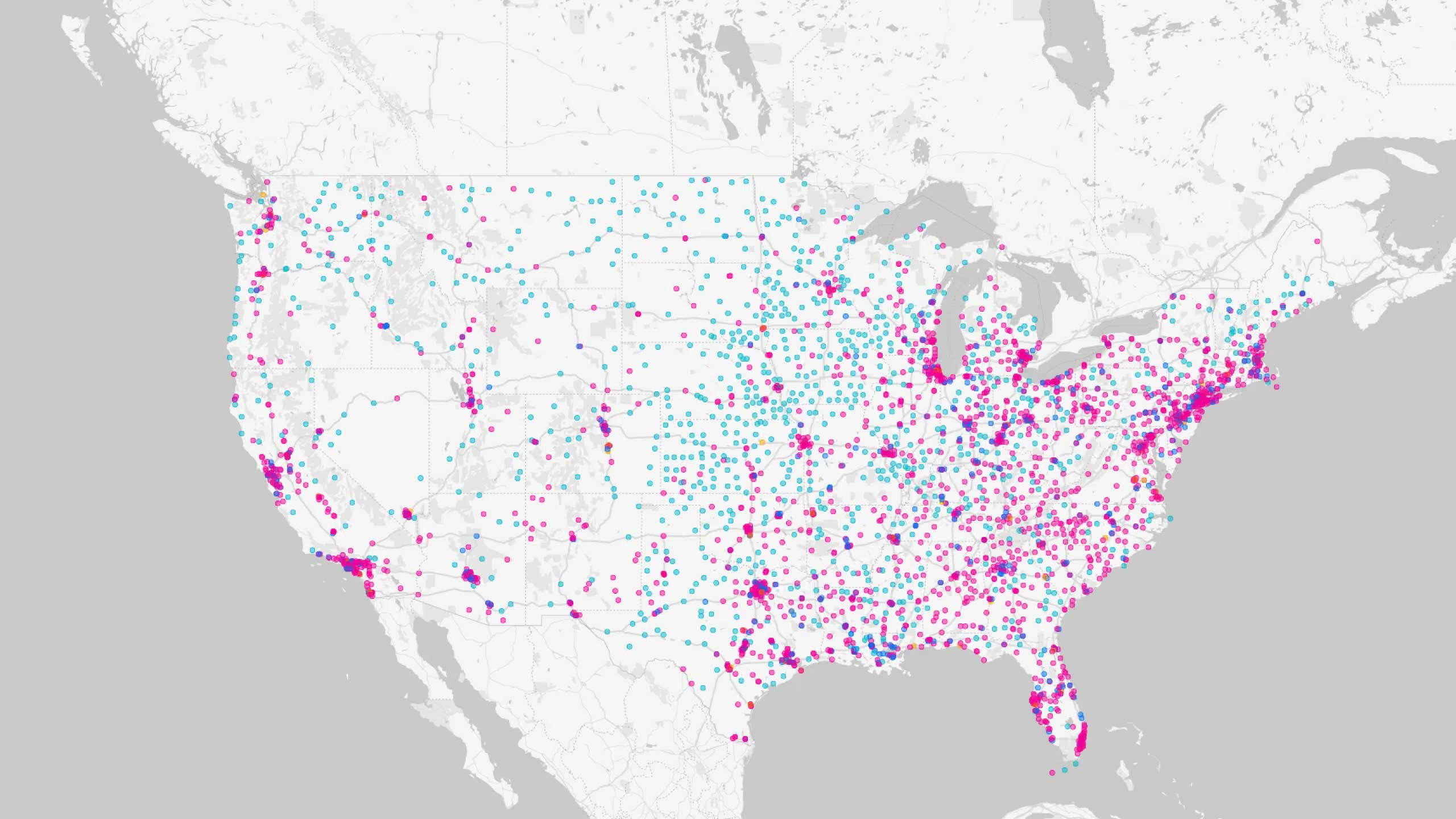
Critical access hospitals are currently located in 45 states. The states with the highest concentrations of CAHs include Texas (88 hospitals), Iowa (82 hospitals), and Kansas (81 hospitals), and states in the Midwest region comprise the largest share nationally at 46%. Each of these facilities faces the same core workforce challenge: the communities they serve are often unable to offer the compensation packages, specialist support networks, career advancement opportunities, or community infrastructure that physicians, particularly those early in their careers, expect.
According to projections published by the AAMC (Association of American Medical Colleges), the United States will face a physician shortage of up to 86,000 physicians by 2036. Rural communities and geographically isolated facilities absorb a disproportionate share of that shortage. A CAH competing for primary care and emergency physicians against urban health systems, federally qualified health centers, and large hospital networks does so at a structural disadvantage.
The result is a familiar pattern: a CAH recruits a permanent physician, that physician serves for two to four years, then relocates for personal or professional reasons, and the facility restarts a recruitment cycle that can take six to eighteen months to complete, all while maintaining mandatory 24/7 coverage through temporary arrangements.
Can a critical access hospital use locum tenens physicians for ongoing 24/7 coverage? Yes. Locum tenens physicians and advanced practice providers can be used to fulfill a CAH's mandatory 24-hour coverage requirements under CMS Conditions of Participation. Many CAHs use locum tenens not only as a bridge during recruitment gaps but as a recurring component of their coverage model, particularly for overnight and weekend shifts where permanent physician availability is limited.
Locum tenens, temporary physician or advanced practice provider placements, typically structured around assignments ranging from a few weeks to several months, has become a functional staffing layer for critical access hospitals, not simply a crisis response mechanism. For facilities that cannot reliably fill and retain permanent physician roles, locum tenens providers offer a predictable and scalable way to maintain coverage without the long-term financial commitments of a permanent hire.
Increased costs of coverage through locum tenens physicians (short-term physician staffing assignments) or other traveling personnel are a recognized element of the financial landscape for rural health facilities managing recruitment and retention challenges. That cost is real, and any CAH administrator evaluating locum tenens coverage needs to account for it honestly. However, the alternative, failing to maintain CMS-required coverage, carries regulatory, financial, and reputational consequences that are considerably more disruptive.
Understanding how a locum tenens staffing process works before selecting a partner helps facility leaders evaluate turnaround time, vetting standards, and accountability structures, all of which matter more in a CAH context than in a larger urban facility with backup resources.
For most CAHs, no single coverage model is sufficient on its own. A hybrid approach (anchored by at least one permanent physician when possible, supplemented by locum tenens for weekends, vacation coverage, and gaps) provides the most operationally stable result.
Advanced practice providers, primarily nurse practitioners and physician assistants, have become a significant part of the 24/7 coverage equation for critical access hospitals. CMS explicitly recognizes PAs and NPs with emergency care training as qualifying personnel for the on-call coverage requirement, which gives CAHs scheduling flexibility that a physician-only model does not.
This mirrors a broader shift in how rural healthcare systems approach coverage gaps. As physician staffing solutions evolve to address the national supply shortage, advanced practice providers are increasingly deployed in expanded roles, particularly in settings where physician supervision can be provided remotely or through a collaborative agreement with an off-site physician.
For CAH administrators, this means that a staffing partner capable of placing qualified APPs in addition to physicians provides meaningfully broader coverage options than one that focuses exclusively on physician placement.
What role do advanced practice providers play in critical access hospital staffing? CMS Conditions of Participation allow CAHs to fulfill their 24/7 coverage requirement using nurse practitioners, physician assistants, or clinical nurse specialists with emergency care training, in addition to physicians. This flexibility is operationally significant for facilities that cannot maintain a full physician roster. APPs are increasingly deployed in expanded roles at rural CAHs, often supported by collaborative agreements with off-site physicians.
Choosing the right staffing partner is among the most consequential operational decisions a CAH administrator will make. The qualities that matter most in a high-volume urban health system (speed to fill open shifts, breadth of database, aggressive pricing) are less predictive of success in a CAH context than factors specific to rural placement.
A staffing partner supporting a critical access hospital should demonstrate:
Understanding what distinguishes a reliable locum tenens staffing partner from one that treats rural placements as an afterthought requires asking direct operational questions during the evaluation process, not just reviewing a candidate catalog.
CAHs operate under a distinct set of CMS Conditions of Participation that standard acute care hospitals do not face. The 25-bed cap limits patient volume and revenue, the 96-hour average length-of-stay requirement shapes the clinical model toward stabilization and transfer rather than comprehensive inpatient care, and the 35-mile geographic threshold removes the facility from most physicians' standard job search radius. Together, these conditions mean that standard recruitment strategies (job boards, compensation benchmarking against urban markets, broad applicant funnels) are largely ineffective. CAH staffing requires a targeted approach oriented around rural-specific placement.
CMS requires that a CAH maintain physician or qualified midlevel coverage (including physician assistants, nurse practitioners, or clinical nurse specialists) with emergency care training either on-site or on call and available within 30 minutes at all times. This applies 24 hours a day, 7 days a week, including holidays and overnight shifts. Facilities cannot waive or defer this requirement based on staffing shortages. In practice, it means a CAH must have a coverage plan that accounts for every hour of the calendar year, which is why temporary and locum coverage is routinely built into the scheduling model rather than treated as a last resort.
Most operationally stable CAHs use a hybrid coverage model: one or two permanent physicians or APP staff who cover the core schedule, supplemented by locum tenens providers for overnight and weekend shifts, vacation gaps, and periods between permanent hires. This structure keeps the permanent compensation burden manageable while ensuring that the 24/7 CMS coverage requirement is met year-round. Facilities that attempt to run exclusively on permanent staff frequently encounter extended coverage gaps when those staff members leave, because the recruitment cycle for rural physician roles can take six months or longer to complete.
An extended physician vacancy at a CAH creates layered operational risk. In the short term, the facility must source emergency locum coverage, often at higher cost and with less lead time for vetting. If coverage cannot be maintained, the facility risks violating its CMS Conditions of Participation, which can trigger survey activity and, in severe cases, jeopardize CAH certification and the associated Medicare cost-based reimbursement. The financial exposure of losing CAH status is substantially greater than the cost of proactive locum tenens coverage. Facilities that treat staffing gaps reactively tend to face both higher short-term costs and greater regulatory exposure than those that plan for gaps in advance.
Evaluation should focus on specificity rather than general capability. Ask prospective partners directly: How many CAH placements have you completed in the last 12 months? Do you have physicians or APPs who have completed assignments in settings with fewer than 25 beds and rural geographic constraints? What is your typical time-to-fill for rural emergency medicine or primary care locum positions? What is your process when a placed provider cannot fulfill a scheduled shift? A partner that answers these questions with data and process descriptions is more likely to perform reliably in a CAH context than one that offers general assurances about candidate database size.
Frontera's model is built around dedicated account management rather than high-volume transactional placement. For geographically isolated facilities, that means one point of contact who understands the specific coverage gaps, scheduling constraints, and clinical environment, rather than a different recruiter on every interaction. Frontera focuses on fit and retention rather than fill speed, which matters considerably more for CAHs, where a poor placement in a rural setting is more disruptive than in a facility with backup staffing layers. The focus is on physicians and advanced practice providers who are positioned and aligned for rural assignments, not candidates for whom rural placement is a secondary option.
Share this video at


Turn this into action with AI