
Facility Resources
Risk Considerations in Healthcare Staffing Solutions Agreements
Navigate risk in healthcare staffing solutions agreements with internal prep steps that protect outcomes.
.avif)

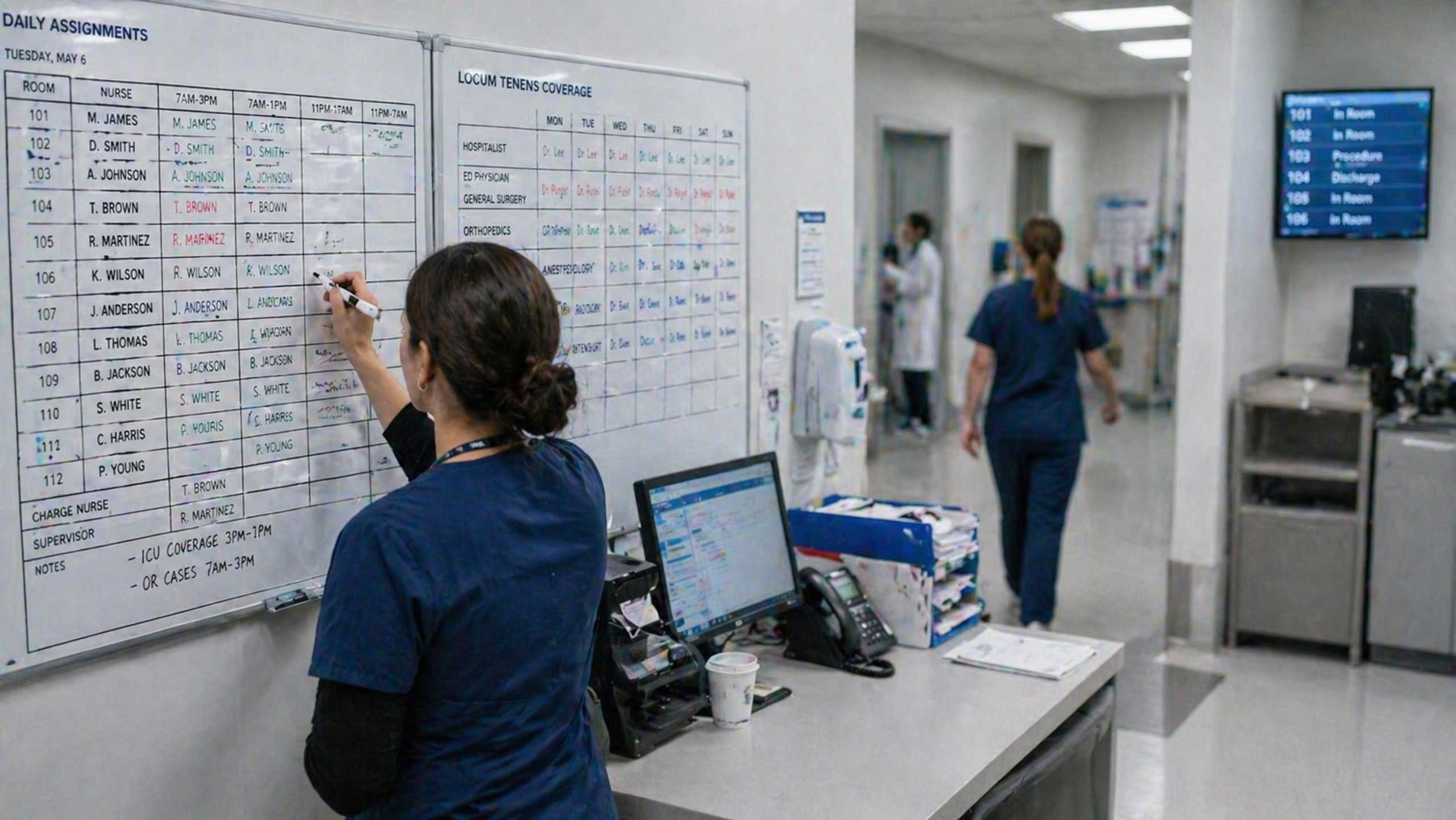
Community hospitals operate with narrower staffing margins than large urban health systems, which makes scheduling reliability a persistent operational challenge. When a physician or advanced practice provider is unexpectedly absent, the downstream effects reach every function of the facility. Understanding how locum tenens positions function within a scheduling strategy, and why structured placement matters more than reactive gap-filling, is the starting point for building predictable, sustainable clinical coverage.
Locum tenens, from the Latin meaning "one holding a place," refers to short-term clinical assignments used to maintain provider continuity when a facility is short-staffed. In community hospitals, these arrangements have historically been treated as a last resort. That approach creates exactly the scheduling instability that administrators are trying to avoid.
The role of locum tenens positions in scheduling stability depends almost entirely on when and how they are engaged. Facilities that treat them as a reactive measure, initiated only after a vacancy has disrupted operations, will consistently experience the same problems. Facilities that build locum coverage into their scheduling framework in advance are in a fundamentally different position.
Community hospitals most commonly use locum positions to cover:
The distinction between reactive and proactive locum use is not simply a matter of lead time. It reflects a broader operational philosophy about how staffing risk is managed, and whether scheduling is treated as a planned function or a crisis-response function.
Scheduling instability in community hospitals generates costs across clinical, administrative, and workforce dimensions simultaneously. Recognizing these costs is the first step toward building a case for a more structured approach.
When provider schedules are unpredictable, patients experience direct consequences. Appointment cancellations, extended wait times, and care provided by clinicians unfamiliar with a facility's protocols are all outcomes of unplanned coverage gaps. In facilities where patient volume is already tightly managed, a single-day gap in physician availability can create a backlog that takes several days to resolve. Continuity of care, the relationship between a provider and a defined patient population — breaks down when the schedule does.
Permanent staff absorb the practical burden of coverage gaps. When a physician or advanced practice provider is unexpectedly unavailable, the remaining team is typically asked to extend hours, expand patient panels, or cover additional clinical responsibilities without advance preparation. This pattern, repeated over time, is a primary driver of clinical burnout.
The U.S. Bureau of Labor Statistics projects that employment in healthcare occupations will grow much faster than the average for all occupations from 2024 to 2034, with approximately 1.9 million job openings projected each year on average due to both growth and replacement needs. This sustained demand highlights the ongoing need for healthcare staffing across a wide range of roles.
Reactive locum coverage also places disproportionate strain on administrative teams. Last-minute placement requests require rapid communication across multiple vendors, compressed onboarding timelines, and unplanned scheduling revisions, all of which consume administrative capacity that would otherwise be directed toward planned operations.
Why Scheduling Instability Compounds Itself?
Inconsistent clinical coverage in community hospitals does not resolve on its own. When permanent staff absorb unplanned gaps through extended hours and expanded patient loads, burnout accelerates, which increases the likelihood of additional departures and future vacancies. Structured locum tenens placement interrupts this cycle by ensuring that coverage needs are anticipated and filled before they create operational disruptions for the care team.
The practical difference between facilities with stable schedules and those with chronic coverage volatility often comes down to how locum placements are coordinated, not simply whether they are used. The table below outlines the key operational differences between reactive and structured approaches:
The table reflects a consistent pattern across community hospital operations: reactive coverage prioritizes filling the immediate gap, while structured placement prioritizes preventing the gap from becoming disruptive in the first place.
Facilities that achieve reliable scheduling outcomes through locum tenens typically share three operational characteristics. These are not vendor-specific features, they are planning disciplines that can be applied regardless of which staffing partner is used.
What Structured Locum Tenens Placement Requires?
Structured locum tenens placement is defined by three operational disciplines: advance planning with 4–8 weeks of lead time, provider continuity across repeat assignments, and dedicated single-point account management. Facilities that apply these disciplines consistently report fewer scheduling disruptions and lower administrative burden than those relying on reactive gap-filling. The benefit is not simply having access to providers, it is having a coordination model that makes coverage predictable.
Not all locum tenens staffing partners are structured to support scheduling reliability. Volume-driven firms, which prioritize filling slots quickly over finding the right fit, often contribute to the same instability they are engaged to resolve. When providers are mismatched to a facility's clinical environment or patient volume, placements end early, schedules are disrupted, and the administrative burden of re-sourcing begins again.
Facility operations leaders evaluating staffing partners for scheduling purposes should assess the following criteria directly:
SHRM emphasizes that proactive workforce planning helps organizations anticipate talent needs and align staffing strategies with future business demands. Organizations that plan ahead are generally better positioned to respond to changing workforce requirements than those that rely on reactive hiring approaches. This principle can be applied to environments with variable demand, such as healthcare staffing.
For a detailed look at how Frontera's placement process is structured, facility leaders can review the step-by-step coordination model, from initial needs assessment through provider onboarding and ongoing scheduling support.
For community hospitals with 150 beds or fewer, the segment where staffing margins are thinnest and scheduling disruptions have the most immediate clinical impact, a stable locum coverage model has several distinguishing characteristics:
Harvard Business Review emphasizes the importance of structured decision-making, clear communication, and coordination in managing complex organizational environments. Research on high-reliability organizations similarly highlights the role of accountability, standardized processes, and continuous oversight in sustaining performance. Healthcare systems, including community hospitals, operate in similarly complex environments where these principles are critical.
What Community Hospitals Should Look for in a Locum Staffing Partner?
Community hospitals evaluating locum tenens staffing partners for scheduling stability should prioritize three structural features: dedicated account management with a single point of contact, transparent advance planning with documented lead times, and a formal commitment to provider continuity across repeat assignments. These features, not simply the size of a firm's candidate database, determine whether a staffing relationship supports or undermines schedule reliability over time.
In healthcare staffing, the culture within a staffing firm shapes the quality of every placement it makes. Firms that operate on high-volume, churn-and-burn models, where recruiters are measured purely against placement numbers, tend to prioritize speed over fit. That model produces placements that look successful in the short term but generate the downstream scheduling disruptions that frustrate facility leaders.
Frontera Search Partners was built around a deliberately different operating philosophy: that treating recruiters well leads to recruiters treating clients and clinicians well, and that this people-first approach produces placements that hold, relationships that last, and schedules that remain stable. For community hospitals that have experienced the operational costs of volume-driven staffing, that distinction matters in practical terms.
Facilities ready to evaluate whether a more structured locum tenens approach would improve their scheduling reliability can connect with the Frontera team directly to discuss their specific coverage environment.
A locum tenens position is a short-term clinical assignment that allows a qualified physician or advanced practice provider to fill a staffing gap at a healthcare facility. These arrangements are appropriate in a range of situations: planned provider absences, unexpected vacancies, seasonal patient volume increases, and recurring part-time coverage needs. Community hospitals, which typically operate with leaner staffing margins than large health systems, are among the settings that benefit most from having locum coverage integrated into their scheduling strategy rather than treated as a last resort.
The general guidance from staffing operations practice is 4–8 weeks of lead time for most specialty placements. This allows the staffing partner to identify candidates who match the facility's specific clinical environment, patient volume expectations, and team culture, rather than defaulting to whoever is immediately available. For recurring gaps, such as coverage during a physician's annual leave, earlier engagement allows the facility to secure the same provider across multiple assignment cycles, which improves continuity and reduces onboarding burden.
Yes, and provider continuity is one of the most operationally valuable, and most underutilized, elements of a structured locum tenens strategy. When the same clinician returns for a second or third assignment at a facility, onboarding time decreases, patient interactions improve, and the administrative burden on permanent staff is significantly reduced. Achieving this requires that the facility communicate the preference to their staffing partner early, so the returning provider can be offered the assignment before a new candidate search is initiated.
When locum placements are managed reactively or poorly coordinated, permanent staff absorb the gap, typically through extended hours, expanded patient panels, or unplanned procedure coverage. Over time, this creates compounding workload pressure that accelerates burnout and increases voluntary turnover. The practical outcome is a cycle in which short-term gap-filling contributes to the conditions that generate new, longer-term gaps. Structured locum coverage reduces unplanned overtime among permanent staff by ensuring that vacancies are anticipated and filled before they create scheduling emergencies.
Community hospitals with 150 beds or fewer, outpatient clinics, physician groups, and federally qualified health centers tend to benefit most from a structured approach. These organizations typically have less internal redundancy to absorb unplanned vacancies and cannot spread scheduling risk across a large permanent workforce. A well-managed locum strategy provides a scheduling buffer that smaller facilities cannot build into their permanent staffing model, and does so without the administrative complexity of managing multiple vendor relationships simultaneously.
Frontera assigns each facility a dedicated account manager who is responsible for all placement coordination, provider communication, and scheduling logistics throughout the relationship. Rather than rotating contacts or managing placements through a shared service model, facility leaders work with one consistent person who understands the facility's clinical environment, staffing patterns, and expectations. Frontera also prioritizes provider continuity, returning the same clinicians to the same facilities across repeat assignments where possible, and focuses on advance planning rather than reactive sourcing. The approach is designed to make locum coverage feel operationally reliable rather than unpredictable.
Share this video at


Turn this into action with AI